Some days, work ends on paper but carries on in your shoulders, jaw and racing thoughts. You may get through the front door, put the kettle on and still feel as though you are answering emails in your head. Learning how to unwind after work is not about becoming perfectly calm by 7pm. It is about giving your body and mind a clear, kind signal that you are safe to stop performing for the day.
For many men, especially those who spend their working lives being capable, contained or careful around others, that transition can be surprisingly difficult. The need may not be for another achievement or distraction. It may be for quiet, warmth, restorative touch, or simply a few private moments where you can relax and be yourself without judgement.
Why work can stay in the body
Stress is not only a thought. It can appear as a tight chest on the train home, clenched hands while making dinner, shallow breathing or the sense that you cannot properly settle. Even when your work is fulfilling, your nervous system may have spent the day responding to deadlines, noise, decisions, meetings and other people’s expectations.
That is why scrolling aimlessly, drinking more than you intended or immediately starting another task often fails to bring real relief. These habits can numb the edge for a while, but they do not always create a true change of pace. Your body needs a transition as much as your diary does.
The best evening routine is not necessarily the most impressive one. It is the one you can return to on an ordinary Tuesday, when your energy is low and you need comfort rather than another set of rules.
How to unwind after work with a proper transition
A short ritual between work and home life can make a meaningful difference. It does not need to be elaborate. The point is to mark the end of one role before stepping into the next.
Change your physical setting
If you work from home, avoid closing the laptop and moving straight to the sofa with it still beside you. Put it away, even if that means placing it in a drawer or covering it with a blanket. If possible, leave the house for ten minutes, walk around the block, or stand outside and take a few slower breaths before coming back in.
For those travelling home, use part of the journey as a buffer rather than a second workplace. You might listen to calming music, look out of the window without filling every gap with your phone, or let yourself arrive in silence. Small choices like these help your mind understand that the working day is over.
Changing clothes is another simple but powerful signal. Taking off restrictive workwear, having a warm shower and putting on soft, comfortable clothes can release more tension than people expect. If femininity, lingerie or a softer presentation is part of what helps you feel at home in yourself, your own private space can be a gentle place to enjoy that expression. There is no need to justify what brings you comfort, provided it feels safe and right for you.
Let your body slow down first
When you are overstimulated, trying to think your way into relaxation can feel impossible. Start with the body instead. Run a warm bath, stretch your neck and lower back, lie on the floor for a few minutes, or make yourself a proper meal without rushing through it.
Notice where you are holding tension, but do not turn this into another performance. You are not trying to fix yourself. A hand on your chest, a few long exhales and the permission to do less can be enough to soften the pressure.
A useful approach is to make your evening sensory in a calming way. Dim the lights, choose a scent you associate with rest, wrap yourself in a clean dressing gown, or use music that does not demand your attention. Sensual relaxation simply means being present with comforting sensations. It does not need to be sexual to feel deeply soothing.
Give your mind somewhere to land
A busy mind often needs acknowledgement before it can quieten down. Keep a notebook by the kettle or bedside and write down the three things still circling in your head. They may be tasks for tomorrow, worries you cannot resolve tonight, or something you want to remember. Once they are on the page, you have less reason to rehearse them repeatedly.
Then choose one activity that is genuinely restful for you. Reading, cooking, gaming, gardening, a familiar television programme or a call with someone who makes you feel at ease can all work. The question is not whether an activity looks productive. Ask yourself whether you feel more settled afterwards.
Choose comfort over escape
There is a difference between relaxing and avoiding. A glass of wine, a takeaway or an evening online can be enjoyable, but it helps to notice whether they leave you restored or simply delayed. There is no shame in wanting a distraction after a demanding day. The aim is to add forms of comfort that help you come back to yourself too.
For example, you might decide that your phone stays in another room while you eat, or that you will take a shower before opening social media. These are not strict wellness rules. They are small boundaries that give your attention a chance to rest.
If you live with others, you may also need to say clearly that you need twenty minutes to decompress before talking about chores, plans or problems. That is not selfishness. It is a respectful way to arrive more present for the people around you.
When touch and care would help more
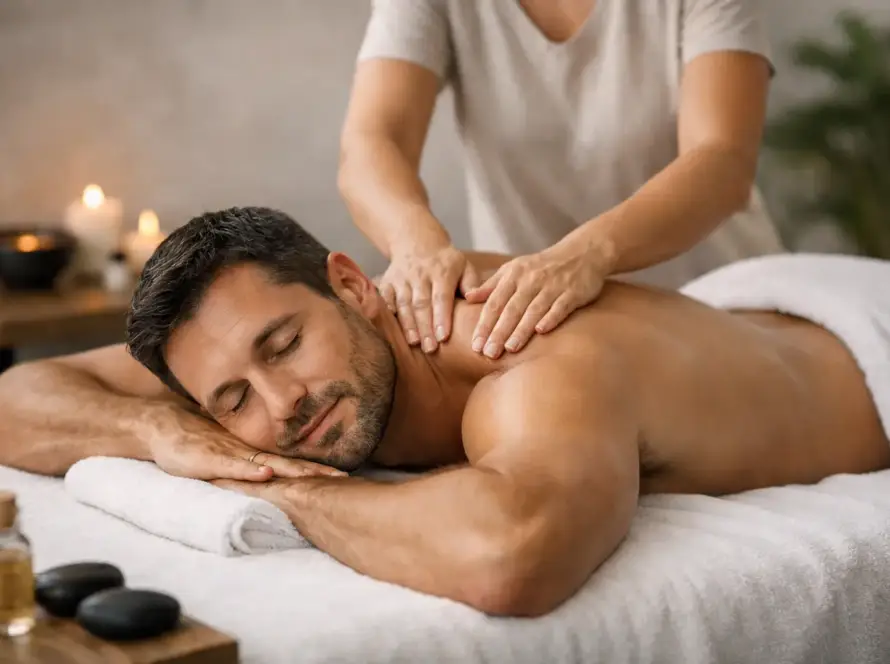
Sometimes the tension has built up over weeks, and home rituals are not quite enough. Professional massage can offer a dedicated space to stop managing everything for a while. The value is not only in easing tired muscles. Safe, respectful touch can support emotional comfort, help you reconnect with your body and make rest feel more accessible.
At Blissful Serenity Massage Therapies, men are welcomed without judgement for personalised, sensual but strictly non-sexual massage. The focus is on relaxation, discretion and professional boundaries, with space for clients to feel comfortable in their own skin. For some, that means a calming Swedish-style treatment; for others, it is the reassurance of being met with warmth and acceptance by a male therapist.
The right practitioner should never make you feel pressured, rushed or uncertain about boundaries. Before booking any treatment, be honest with yourself about what you need: relief from physical tension, a quieter mind, affirming care, or time away from the demands of everyday life. A good massage experience is collaborative, and your comfort should lead every part of it.
Build an evening that fits your real life
You do not need two uninterrupted hours and a spotless home to recover from work. On some evenings, five minutes of quiet breathing while the pasta boils is all that is realistic. On others, you may want a long bath, an early night or an unhurried walk.
Try creating a loose sequence rather than a rigid routine: finish work, change your environment, eat or drink something nourishing, then choose one comforting thing for your body and one for your mind. Repeating the same gentle cues can make unwinding easier over time because your system begins to recognise them.
Pay attention to the evenings when you sleep better or wake with less heaviness. Those are useful clues. You may find that a phone-free hour helps, that a warm shower is essential, or that you need company after a socially demanding day rather than more solitude. There is no single correct way to rest.
Give yourself permission to stop
Many men have learned to treat rest as something that must be earned after every task is complete. But there will always be another message, another household job, another reason to stay switched on. Rest is not a reward for exhaustion. It is part of looking after your physical health, emotional wellbeing and sense of self.
Tonight, choose one small act that tells you the day is finished. Let it be uncomplicated, private and entirely yours. You do not have to be entertaining, productive or guarded in that moment. You are allowed to soften.